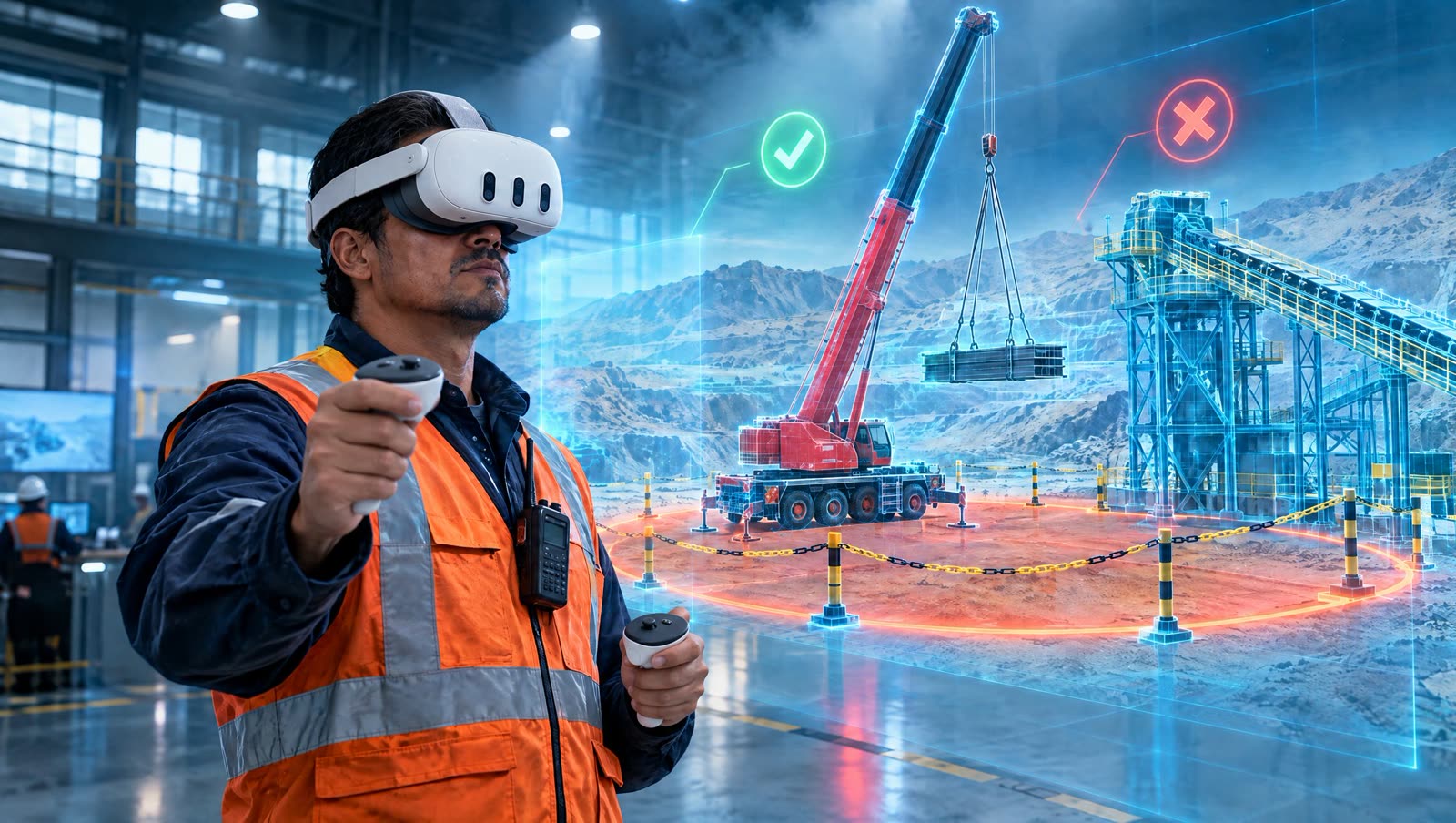
On April 7, 2026, Italy's Legge 11 marzo 2026, n. 34 took effect, published in the Gazzetta Ufficiale no. 68 of March 23. Its Article 10 amended Article 37, paragraph (comma) 5, of Decreto Legislativo 81/2008 —Italy's framework law on occupational safety and health— and added a sentence that until now did not exist in any benchmark European legislation on this subject.
The new part of the text in force reads:
"Gli interventi di addestramento possono essere effettuati anche mediante l'uso di moderne tecnologie di simulazione in ambiente reale o virtuale e devono essere tracciati in apposito registro, anche informatizzato."
In English: hands-on training activities may also be carried out using modern simulation technologies in a real or virtual environment, and must be recorded in a dedicated register, which may be electronic.
Why this matters, and why it needs to be read carefully
So far, the news. Now the part almost no one explains, and the one that determines whether this is useful or not.
The Italian law does not say that safety training can be done in virtual reality. It says something more precise and more interesting: that addestramento can be done that way.
Formazione, informazione, addestramento: three different things
Article 2 of Legislative Decree 81/2008 defines the three separately, and the distinction is exactly what is missing from much of the discussion in our region:
- Informazione (information) — providing knowledge useful for identifying, reducing, and managing risks. It is about communicating.
- Formazione (education) — the educational process for transferring knowledge and procedures that enable people to acquire competencies. It is about knowing.
- Addestramento (hands-on training) — the set of activities aimed at teaching workers the correct use of equipment, machines, installations, substances, and devices —including personal protective equipment— and work procedures. It is about doing.
What Italy has just enabled is simulation for the third one. For the practical test. For the moment when the person has to perform, not recite.
And that is, strictly speaking, the only place where simulation had anything to contribute.
What the law does not say
We are a simulator provider, so it is better that we be the ones to draw the limits before someone else does:
- It does not set a maximum percentage of hours that can be done in simulation. The law does not quantify.
- It does not establish technical requirements for the technology. It does not define what counts as a valid simulator.
- It does not remove the existing conditions. Addestramento must still be carried out "da persona esperta e sul luogo di lavoro" — by an expert and at the workplace.
- It does not replace theoretical training or the regulated delivery formats.
- It does not make virtual reality mandatory or preferred. It enables it. Nothing more, and nothing less.
The traceability requirement, on the other hand, is explicit: all addestramento must be recorded. That requirement already existed, but it now sits alongside a technology that produces that record by design.
The precedent that makes the change visible
In May 2024, the University of Siena formally asked the Italian Ministry of Labor (Ministero del Lavoro) whether it could use virtual reality as a learning and assessment method in safety training.
The Commissione per gli interpelli (the ministry's rulings committee) replied, in Interpello n. 3/2024, that the agreements in force had to be followed and that the agreement applicable at the time "non cita espressamente tale possibilità" — does not expressly mention that possibility.
Two years later, the legislature wrote it in. That is the full arc: from "the rules do not contemplate it" to "the rules expressly contemplate it" in twenty-three months.
A warning about what you will find when you search for this
If you search for this news, you will come across many pages that attribute the authorization of virtual reality to the Accordo Stato-Regioni of April 17, 2025, Italy's new agreement on safety training, published in the Gazzetta Ufficiale no. 119 of May 24, 2025.
That is incorrect, and it is worth saying so.
That agreement regulates the delivery channel for training —in person, synchronous videoconference, e-learning— and establishes that practical sessions remain in person. It does not mention virtual reality, augmented reality, or immersive environments. In fact, if it had, the 2026 legal reform would not have been necessary: its very existence proves there was a gap.
We checked this because publishing an incorrect regulatory citation, in an industry that sells compliance, is the fastest way to lose the credibility it takes years to build.
What this means for Chile
Nothing, in legal terms. And everything, in terms of argument.
In legal terms: an Italian law does not change the Chilean framework. DS 44 (Chile's occupational risk-prevention decree) and the Technical Training Guide (Guía Técnica de Capacitación) approved by Resolución Exenta 1.117 —in force from November 1, 2026— are the rules that apply here. Anyone who tells you the Italian reform enables something in Chile is selling you smoke.
In terms of argument, it is a different story. There are three points that connect.
First, the Compendium of Rules for the Social Insurance under Ley 16.744 (Chile's workplace accident and occupational disease insurance law) already expressly mentions "interactive simulators and experiential workshops" among the valid training formats that the insurance administrators must offer. Recognition is not foreign to our regulations: it is there, albeit with less force.
Second, the Chilean Technical Guide requires verifying actual understanding, not attendance, with individual certification tied to each worker. Italy has just recognized that the technology that produces this kind of evidence is valid for the practical component. These are two regulations moving in the same direction from different angles.
Third, and perhaps most relevant: in March 2026, SENCE (Chile's national training agency, which administers the training tax credit) eliminated distance self-learning from the training tax credit (franquicia tributaria) due to the "absence of tools that make it possible to objectively verify the user's participation and the learning outcomes achieved". That sentence describes a requirement, not a ban on technology. And it describes exactly what a simulation system records.
What you can do with this
If you are evaluating simulated training and need to make the case internally, this is a solid and verifiable precedent: a benchmark European legislation has just written simulation in a virtual environment into the text of its workplace safety law, for the practical component, while keeping the requirements for an expert and for record-keeping.
It is not proof that the technology works —that is what the studies are for, and we have already published several—. It is a signal of where regulation is heading in countries that are decades ahead in this discussion.
What you cannot do is cite this as Chilean regulatory compliance. We don't, and be wary of anyone who does.
Sources: Gazzetta Ufficiale — Legge 11 marzo 2026, n. 34 (GU n. 68 del 23-03-2026) · Normattiva — Legge 11 marzo 2026, n. 34 · Ministero del Lavoro — Accordo Stato-Regioni del 17/04/2025 · Interpello n. 3/2024 — use of virtual reality in training · SUSESO — Compendium of Rules for the Ley 16.744 Insurance, Ch. V · SENCE — Exempt Resolution 632 eliminates distance self-learning