At most companies, that question has no answer. There are binders with attendance sheets, scanned certificates, and accumulated hours. All of it proves that the training happened. None of it proves that the competence exists.
The distance between those two things is where accidents live. And starting in November, it is also where inspectors will be looking.
The drill is scheduled. The fire isn't.
Emergency exercises are coordinated: an email goes out, production is consulted, a quiet day is chosen, and it is done in the yard in good light. That is reasonable from an operational standpoint.
The problem is that a real fire doesn't negotiate the schedule. It starts on the night shift, in the aisle between racks, with one person alone who has to decide in seconds whether to attack the incipient fire or evacuate.
That decision is not taught in a presentation. It is trained by repeating it many times, in different scenarios, until it stops being a doubt and becomes a reflex.
Do the math on a live-fire exercise
Add up what a live-fire exercise costs: recharging the extinguishers, the fuel, the blocked-off yard, the work permit, the brigade's labor hours. Now divide that by the number of times each worker actually got to practice.
At most operations the result is the same: once a year, thirty seconds, no repetition, and no individual record.
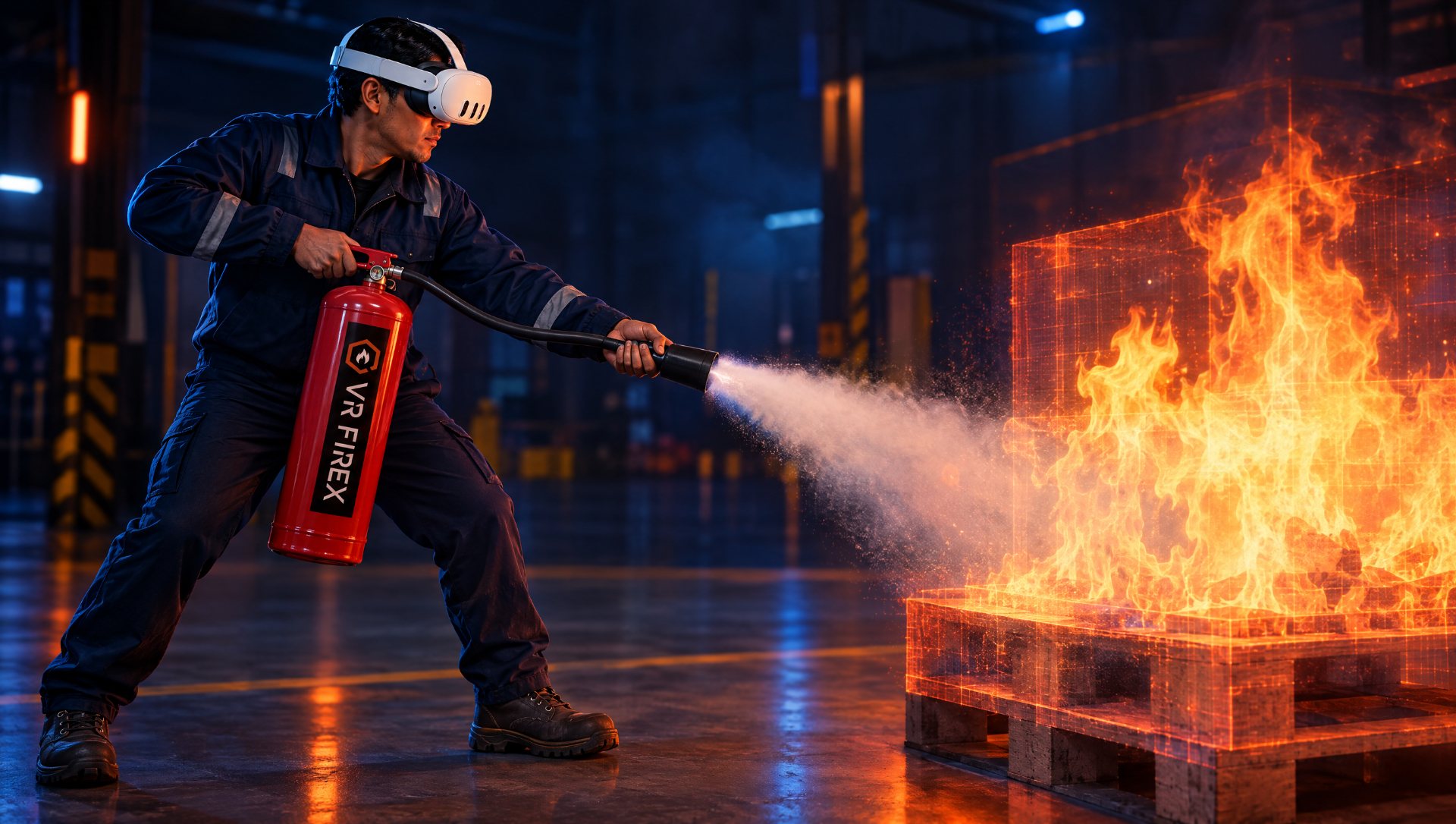
A simulator changes that arithmetic. Practice stops being an annual event and becomes something that can be repeated as many times as needed, without recharging extinguishers, without closing the yard, and without pulling the brigade off the job for half a day.
With VR FIREX, that means Class A, B, and C fires in office, storage warehouse, industrial operation, explosives industry, and mining environments, using a real dry chemical powder extinguisher adapted to the virtual environment. The hand learns the weight of the equipment and the travel of the trigger, not just the concept.
What you get back isn't just budget. It's evidence.
This is where the other half of the system comes in. Every exercise each worker completes is recorded: which scenario they faced, which decisions they made, where they failed, and how much they improved from one attempt to the next.
That is not a certificate. It is a complete trace of how that person was trained. And it lets you walk into a management meeting with data instead of a hunch: what percentage of the workforce has truly mastered the critical procedure, and who still hasn't.
Why this is no longer optional
Supreme Decree 44 (DS 44, Chile's occupational risk-prevention decree), in force since February 2025, requires every worker to receive at least eight hours of training, at intervals of no more than two years, "using methodologies that ensure the worker's adequate understanding". Among the mandatory topics —for every worker, regardless of industry— are fire prevention and the use of fire extinguishers.
In August 2026, Chile also published the Technical Training Guide (Guía Técnica de Capacitación, Resolución Exenta 1.117), which takes effect on November 1, 2026. It sets out the teaching methodology, the assessment mechanisms, and individual certification tied to each worker's identification. Its central point: verification by the labor authority goes beyond mere attendance.
For decades, training records in Chile were a list of signatures. What is inspected now is whether the person understood, and that has to be provable worker by worker.
We are not saying a simulator is the only way to comply with the regulation; it would be dishonest to claim that. We are saying something simpler: a system that measures individual performance produces, by its very nature, the kind of record the regulation now requires, with no additional administrative work.
Five questions to review this week
- Does your preventive work program define how often training happens, and does it respect the two-year maximum?
- Does the content cover the seven mandatory points in Article 16, including the use of fire extinguishers?
- Can you prove understanding —not just attendance— for each person?
- Are your records tied to each worker's individual identification?
- How many times a year does each member of your brigade actually get to practice?
If the fifth question made you more uncomfortable than the other four, you already know where to start.
Our virtual reality fire extinguisher simulator has been in operation since 2018 at more than twenty facilities, in industries ranging from mining to industrial storage. You can see how it works at VR FIREX and how performance is recorded at VR CLASS.
Sources: BCN — Supreme Decree 44 · Dirección del Trabajo (Chilean Labor Directorate) — Article 16 · Undersecretariat of Social Security — DS 44 technical guides