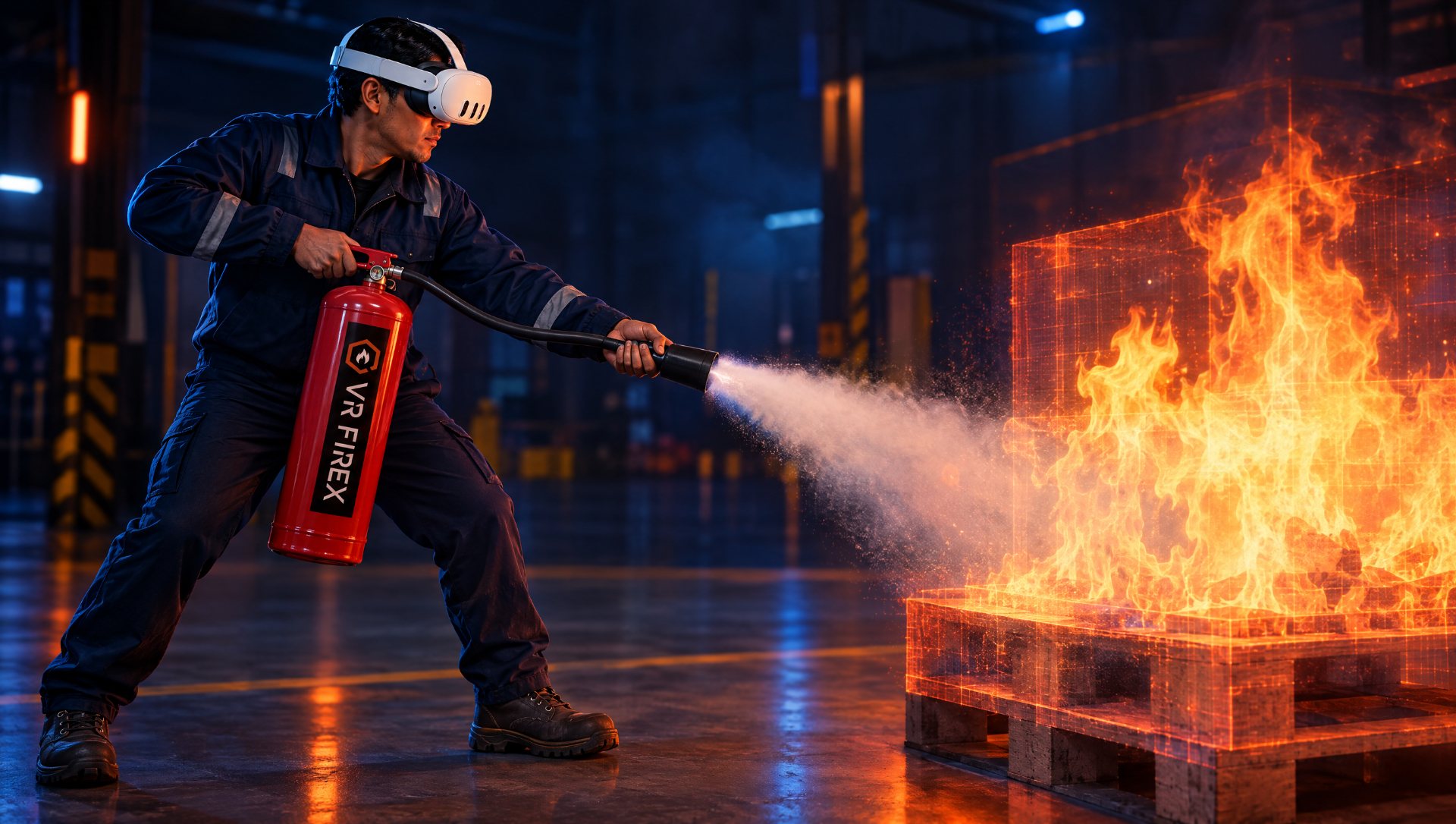
Short answer: VR fire extinguisher training costs less per repetition, uses no consumables, produces no emissions and lets every trainee practice until they get it right, with a scored record of their performance. Live-fire training still matters where a regulator, insurer or certifying body requires a real discharge. The most effective programs use VR for practice and assessment, and live fire to confirm the final hands-on skill.
Cost per trainee
With live fire, cost grows with every person you train: extinguishers to discharge and recharge, fuel, a suitable outdoor area, fire-safe setup, staff time and often an external provider. With a VR simulator such as VR FIREX, the main cost is the equipment and licenses up front. After that, each additional trainee and each additional repetition costs very little. The more people you train, and the more often you retrain them, the wider the gap becomes.
Consumables: powder, recharges and fuel
A live-fire drill consumes dry chemical powder, requires extinguisher recharges and inspections, and burns fuel to create the fire. Dry chemical residue must also be cleaned up. VR training uses a real, adapted extinguisher that never discharges, so there is nothing to recharge, replace or clean.
Emissions and environmental impact
Burning fuel in open pans produces smoke and combustion emissions, and discharged powder ends up on the ground. For companies with environmental or ESG commitments, or sites where open burning is restricted, this is a growing concern. Virtual fire produces no smoke, no residue and no emissions.
Repetitions: once vs. as many times as needed
In a typical live-fire session, each person discharges an extinguisher once, if there is enough equipment to go around. One attempt is rarely enough to build confidence or correct mistakes. In VR, trainees can repeat the exercise as many times as they need, across different fire classes and environments: office, warehouse, industrial plant, explosives storage or mine site. Practice builds the muscle memory that matters in a real emergency.
Scoring and evidence
Live-fire training typically ends with a sign-in sheet. That proves attendance, not competency. VR FIREX scores each trainee on time, technique and distance, and stores an individual report with date and results. Safety managers can see who is ready, who needs more practice and how a crew or contractor is performing overall. That record is useful in audits, inspections and incident investigations.
When live fire is still required
Some regulators, insurers and certifying bodies require a hands-on discharge of a real extinguisher as part of training or certification. Fire brigades and emergency response teams may also need live-fire exposure to heat and smoke that no headset can replicate. In those cases, VR does not replace live fire; it complements it. Trainees arrive at the live-fire session already knowing the technique, so fewer extinguishers are discharged, the session runs faster and the results are better documented.
How to combine both
- Use VR for initial training, practice and periodic refreshers.
- Set a minimum passing score before anyone moves on to live fire.
- Reserve live-fire sessions for the final hands-on check where regulations or insurers require it.
- Keep VR reports together with your training records as evidence of competency.
This article is for general information. Always confirm the fire extinguisher training requirements that apply to your site with your local regulator, insurer or certifying body.