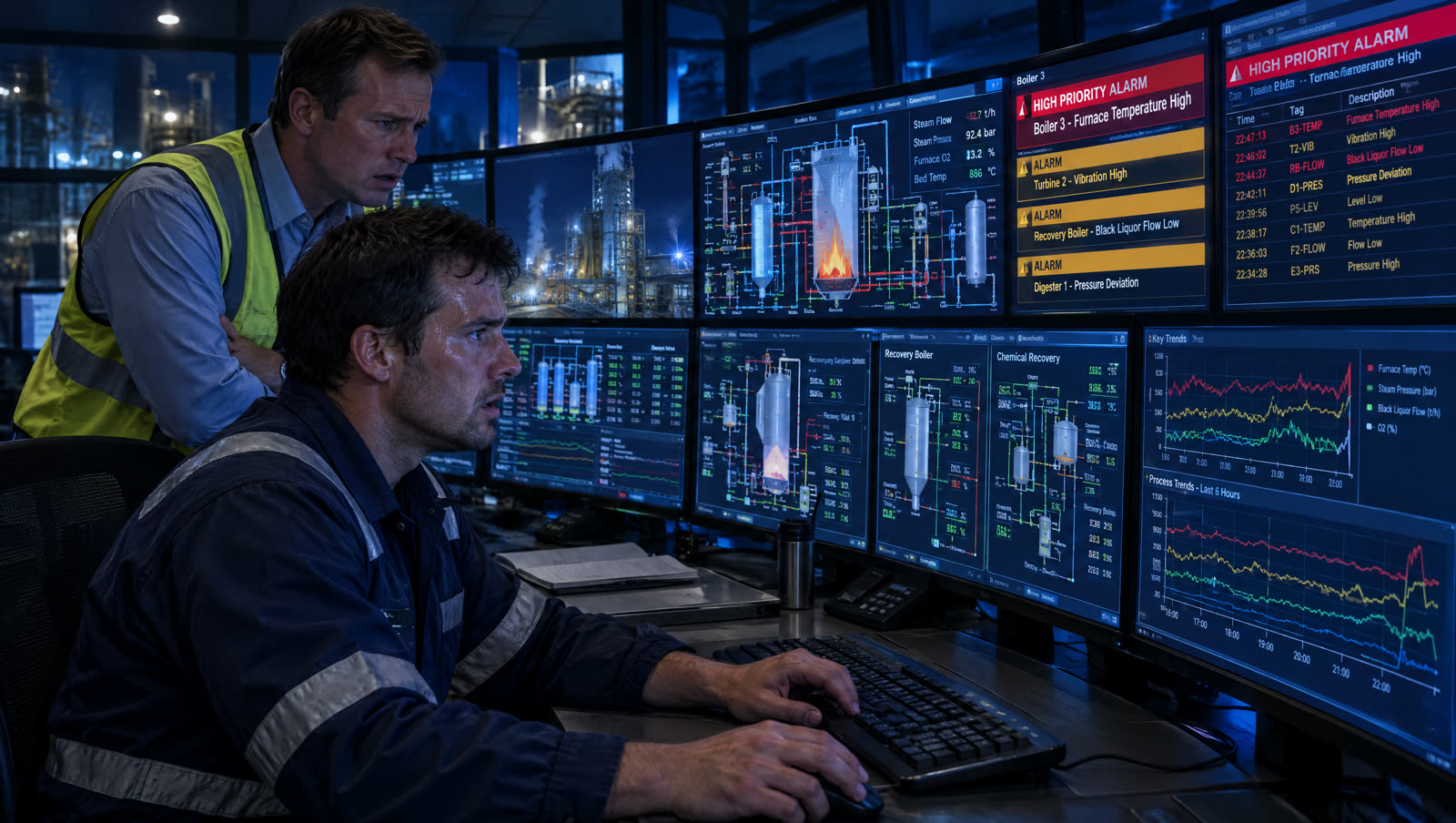
A new operator starts, and the operational answer is always the same: let them learn by watching. They shadow someone experienced, observe maneuvers, perform a few under supervision, and gradually build judgment.
It works. The problem is what it costs and what can't be known.
Three things nobody measures in shadowing-based onboarding
How long it really takes. It is estimated in weeks or months, but the date the person became competent is never a data point: it is the supervisor's impression.
Who they learned from. The new operator's judgment ends up mirroring whichever shift they happened to work alongside. Two people who started the same month can come out with different standards, and the company has no way to notice until something happens.
What they never got to see. This is the most uncomfortable one. In a plant that runs well, serious deviations are rare —which is exactly what you want—. But it means the new operator finishes onboarding without ever having faced the failure they will one day have to resolve alone.
You cannot train someone for an emergency by causing the emergency. And yet that is exactly where you need them to know what to do.
What changes with a digital twin
XTRAINING replicates the control room and the field as a digital twin: not an illustrative animation, but the real logic of the process. The operator trains on startups, shutdowns, stop sequences, deviations, and failures that cannot be triggered in the real plant.
Three practical consequences:
- The plant doesn't stop. Training no longer competes with production for the same equipment and the same shift.
- The difficult scenario can be repeated. The failure that happens once every three years can be rehearsed ten times in an afternoon.
- Judgment no longer depends on the luck of the shift. Every operator faces the same set of situations, against the same reference standard.
The part that makes the difference: knowing where the gap is
Training in a simulator is already better than training by watching. But what really changes management is what comes after the exercise.
The system doesn't hand out a grade. It identifies where each operator failed —which sequence they skipped, which deviation they reacted to late, which parameter they misread— and from that, artificial intelligence builds an individual reinforcement plan.
For an operations manager, that means no longer managing onboarding as a block of time and starting to manage it as a set of concrete gaps that are closed one by one. You know who is ready, who isn't, and exactly what they are missing.
Where it makes sense and where it doesn't
A digital twin does not replace the field. People still need to know the noise, the smell, the vibration, and the real weight of what they operate; that doesn't transfer through a screen.
Where it does pay off is in the decision layer: the logic of the process, the correct sequence, reading a deviation, judgment under pressure. That layer is the one learned today by observation, it is the one that takes the longest, and it is the only one that can be accelerated without risk.
If your plant has operator turnover, critical processes that cannot be rehearsed for real, or an onboarding process whose end no one can define precisely, that is where to look first.
At Qualitat, we believe a machine can replace an ordinary person, but never an extraordinary one. That is what we set out to develop. Learn more about our industrial training solutions.