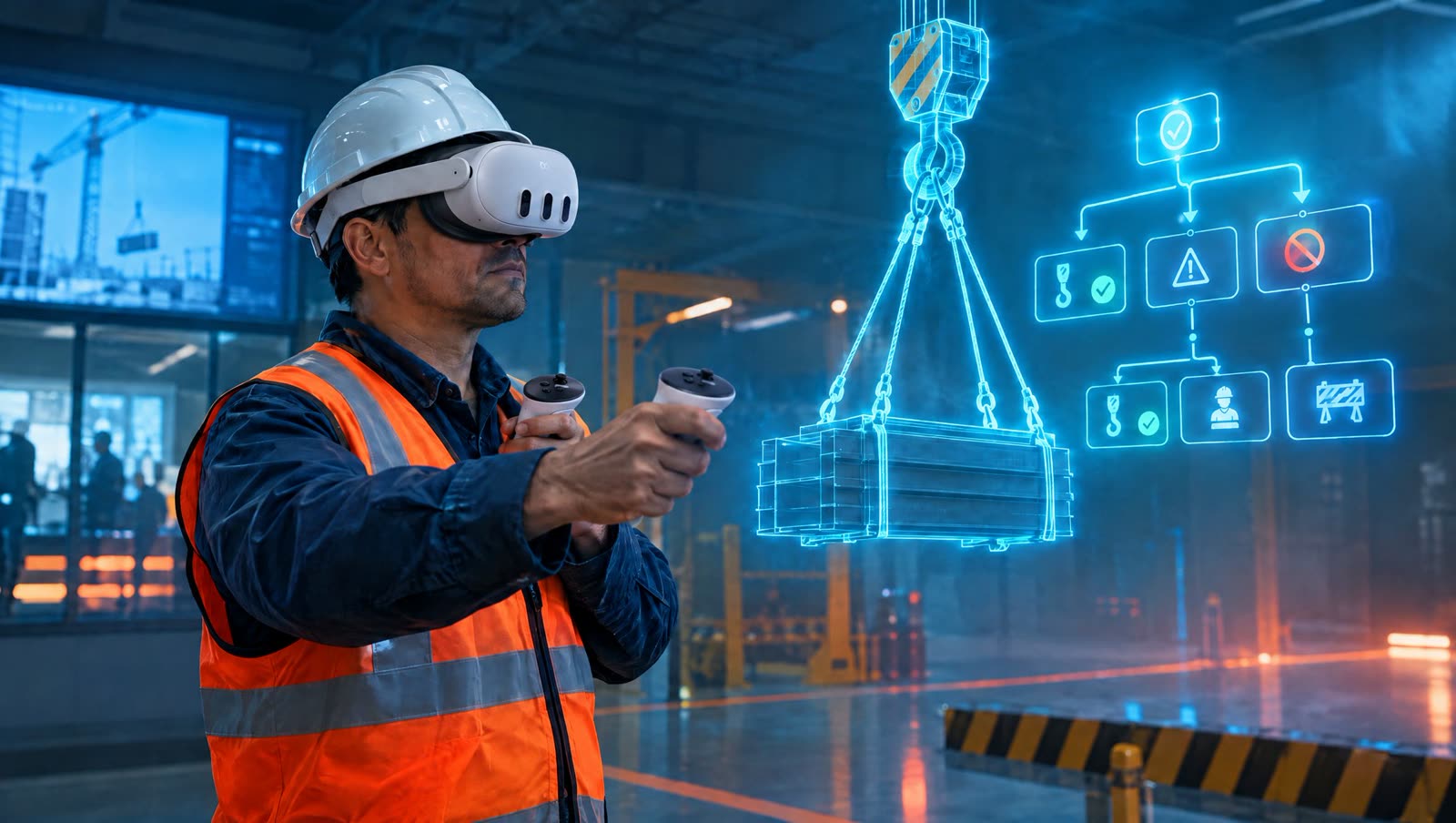
A study published in Construction Management and Economics compared construction safety training in a traditional classroom against immersive virtual reality, with 66 subjects: 41 on-site concrete workers and 25 engineering students. The researchers measured sustained attention during the session.
The classroom group showed a marked drop in concentration after 40 minutes. The virtual reality group stayed focused for the full 90 minutes. The difference was statistically significant, with p=0.0002.
In the same study, hazard identification rose from 9.67 to 13.08 points with virtual reality, compared with 9.77 and 11.17 in the classroom.
What this means for your annual program
If your program includes two-hour talks, you are paying for two hours of room time, two hours of instructor time, and two hours of lost production. And only the first forty minutes are turning into learning.
The rest is attendance, not training.
And in an audit, attendance and training look exactly the same on paper. That is the problem Chile's new Technical Training Guide (Guía Técnica de Capacitación) sets out to correct, by requiring verification of actual understanding.
And how long does what people learn actually last?
Here is a second data point that changes the conversation about frequency.
A controlled experiment compared fire extinguisher training using head-mounted virtual reality against video-based training, and measured again at three and four weeks. The video group showed a significant drop in self-efficacy. The virtual reality group maintained it with no decline.
Self-efficacy is not self-esteem or generic motivation. It is the well-founded belief that you can carry out a specific action when the moment comes. In a real emergency, it is exactly the variable that decides who grabs the extinguisher and who steps back to wait for someone else to arrive.
A third study, with eighteen electrical workers averaging 43.7 years of age, measured training in electrical isolation and pump lockout —a procedure equivalent to LOTO— in 35-minute sessions. Total knowledge rose 105.8% over baseline, and procedural knowledge —knowing the correct sequence of steps— rose 148.7%. Four weeks later, retention was still 66% above the starting point.
Two things stand out. First, the largest effect is on procedural knowledge, which is exactly where LOTO kills people when it is performed out of order. Second, the effect fades but is not erased: after four weeks, two-thirds of it remains.
The practical consequence: cadence, not an event
These three studies point to the same thing from different angles. Emergency competence is not sustained by an annual event. It is sustained by repeated practice, and repeated practice is only viable if it is cheap to repeat.
That is exactly the problem simulation solves, and not because it is more modern: because it can be repeated at no meaningful marginal cost.
An exercise that can be run four times a year, across different shifts, without stopping the plant or mobilizing the entire emergency brigade, keeps competence within the window in which it actually holds.
Three questions to review your program
- How long is each session, and how much of that time is actually producing learning?
- How much time passes between one training session and the next on the same critical procedure?
- Do you have a way to know whether the person can still perform the task, or do you only know that they attended?
If the third question has no answer, the first two stop mattering.
Sources: Sacks, Perlman & Barak — Construction Management and Economics 31(9), 2013 · Buttussi & Chittaro — Virtual Reality (Springer), 2021 · Stefan, Mortimer, Horan & McMillan — Journal of Safety Research 90, 2024